Blaufränkisch: the great red of central Europe, child of gouais
Profile: Blaufränkisch
| Berry colour | Black grape (N) |
|---|---|
| Species / status | Vitis vinifera |
| Origin | Central Europe, probably Lower Styria (present-day Slovenia) |
| Parentage | Gouais blanc × Blaue Zimmettraube (DNA analysis) |
| Synonyms | Lemberger (Germany), Limberger, Kékfrankos (Hungary), Frankovka (Czechia, Slovakia), Modra frankinja (Slovenia) |
| Grown in | Austria, Hungary, Germany, Slovakia, Czechia, Slovenia, Croatia, United States |
| Typical aromas | blackberry, black cherry, blueberry, pepper, spices, mineral and graphite notes |
| Wine style | Coloured reds with fresh acidity and medium tannins, fruity and peppery when young, fuller and deeper after ageing. |
| Food pairings | grilled lamb, game, roast duck, goulash, pressed-curd cheeses |
| Identifiers | VIVC no. 1459, Wikidata Q882859 |
Origin: a “franc” grape of central Europe
Blaufränkisch is a black grape of central Europe. Historical sources place its probable origin in Lower Styria, a region that is now Slovenian. Its first mention under this name dates from an exhibition in Vienna in 1862, but the grape is undoubtedly much older.
Its name means “blue franc”. In the medieval Germanic wine tradition, grapes judged noble were called “franc” (fränkisch), as opposed to so-called “Hun” grapes, considered common and productive. Hungarian kékfrankos (“blue franc”) and Slavic frankovka carry the same idea.
Parentage: gouais once again
DNA analysis established that blaufränkisch comes from a natural cross between gouais blanc and blaue Zimmettraube, an old central European variety.
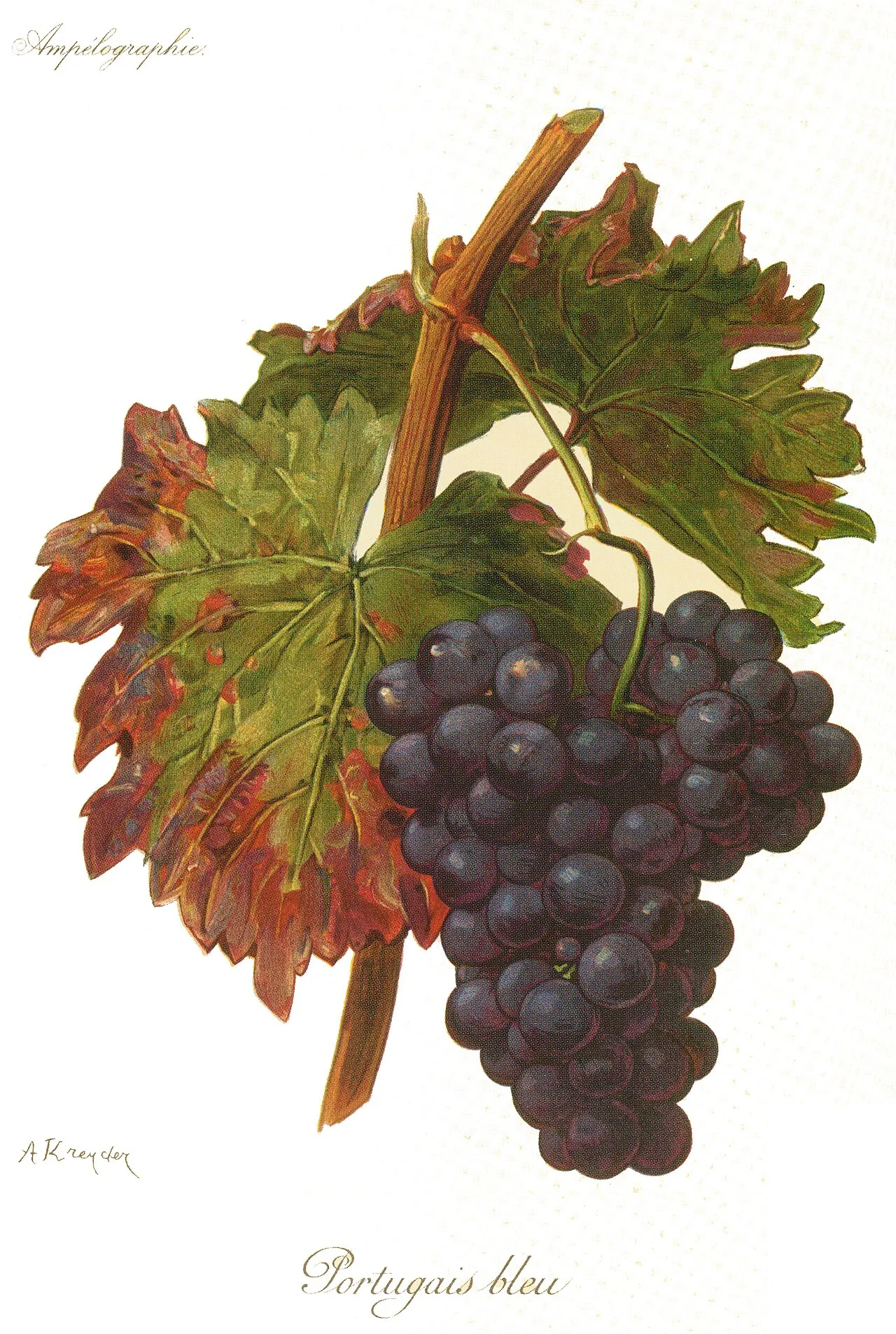
Gouais blanc, the “Hun” grape par excellence, is also a parent of chardonnay, gamay and very many European grapes. Blaufränkisch, a “franc” grape by name, therefore has a parent from the opposite category: a nice paradox. As for blaue Zimmettraube, it is also the mother of portugais bleu. See DNA parentage of grapes.
| Grape | Relationship to blaufränkisch |
|---|---|
| Gouais blanc | Parent |
| Blaue Zimmettraube | Parent |
| Portugais bleu | Half-sibling (same parent: blaue Zimmettraube) |
| Gamay | Half-sibling (same parent: gouais blanc) |
| Zweigelt | Child (saint-laurent × blaufränkisch) |
| Blauburger | Child (portugais bleu × blaufränkisch) |
The little-known angle: the false gamay
For a long time, blaufränkisch was confused with gamay. The two grapes sometimes resemble each other in their fruity wines, but DNA showed they are different varieties.
The irony of history: the confusion was not entirely unfounded, since the two grapes do have a common parent, gouais blanc. They are therefore half-siblings. For pitfalls of this kind, see synonyms and homonyms. On gamay itself, see our comparison gamay or pinot noir.
In the vineyard
Blaufränkisch buds early and ripens late: it is therefore exposed to spring frosts and needs warm, well-exposed sites. It is susceptible to downy mildew. Vigorous and productive, it gives dilute wines if not controlled, hence the importance of low yields for quality cuvées.
The wines
Blaufränkisch makes coloured reds, with fresh acidity and medium tannins, with aromas of blackberry, black cherry and pepper. Unoaked versions are lively and fruity; barrel-aged versions are fuller and deeper, suited to ageing. On slate or limestone soils, it often takes on a mineral dimension.
Its nickname “pinot noir of the East” reflects its ability to express terroir, more than any aromatic resemblance.
Austrian terroirs
In Austria, blaufränkisch is the second most planted red grape, behind zweigelt. It is concentrated in Burgenland, in the east of the country, where several DAC appellations are devoted to it.
| Appellation | Character |
|---|---|
| Mittelburgenland DAC | The “Blaufränkischland”, powerful and fruity wines |
| Leithaberg DAC | Limestone and slate soils, taut wines |
| Eisenberg DAC | Slate soils, spicy and mineral wines |
| Rosalia DAC | Fresh and fruity wines |
Austria is also the country of grüner veltliner, its great white grape.
Elsewhere
- Hungary: under the name kékfrankos, it is one of the most planted red grapes and a pillar of Eger’s Bikavér, where it has taken the place of kadarka.
- Germany: under the name lemberger, mainly in Württemberg.
- Slovakia, Czechia, Slovenia, Croatia: under the names frankovka or modra frankinja.
- United States: small areas, notably in Washington State and New York.
Tasting notes
A blaufränkisch is recognised by its deep colour, its aromas of blackberry and black cherry lifted with pepper, and a palate with fresh acidity supported by clean tannins. Young unoaked wines are served at around 15 to 16 °C; terroir cuvées aged in barrel benefit from a few years of cellaring.
Frequently asked questions
Is blaufränkisch a gamay?
No. It was long considered a form of gamay. DNA analysis showed it is a distinct variety, from gouais blanc and blaue Zimmettraube. The two grapes do, however, share a parent, gouais blanc.
What is the difference between blaufränkisch, lemberger and kékfrankos?
None as far as the variety is concerned: they are three names for the same grape. Blaufränkisch is the Austrian name, lemberger (or limberger) the German name, used notably in Württemberg, and kékfrankos the Hungarian name, which also means "blue franc".
Where can the best blaufränkisch be found?
In Austria, in Burgenland: Mittelburgenland, nicknamed "Blaufränkischland", Leithaberg, Eisenberg and Rosalia each have a DAC appellation that showcases it. In Hungary, it is very widely planted, notably in Sopron and in the blends of Eger and Szekszárd.
Which grapes come from blaufränkisch?
The best known is zweigelt, a cross of saint-laurent and blaufränkisch, which has become the most planted red grape in Austria. Blauburger, from portugais bleu and blaufränkisch, is another of its descendants.
Related grapes
- Portugais bleu (black, Central Europe, probably Lower Styria (present-day Slovenia))
- Gamay (black, France, Burgundy)
- Kadarka (black, Balkans or Pannonian basin (debated origin))
- Grüner veltliner (white, Austria, Lower Austria)
- Pinot noir (black, France, Burgundy)
- Chardonnay (white, France, Burgundy)
- Aramon noir (black, France, Languedoc)
- Melon de Bourgogne (white, France, Burgundy)