Kadarka: the historic grape of Szekszárd and Bikavér
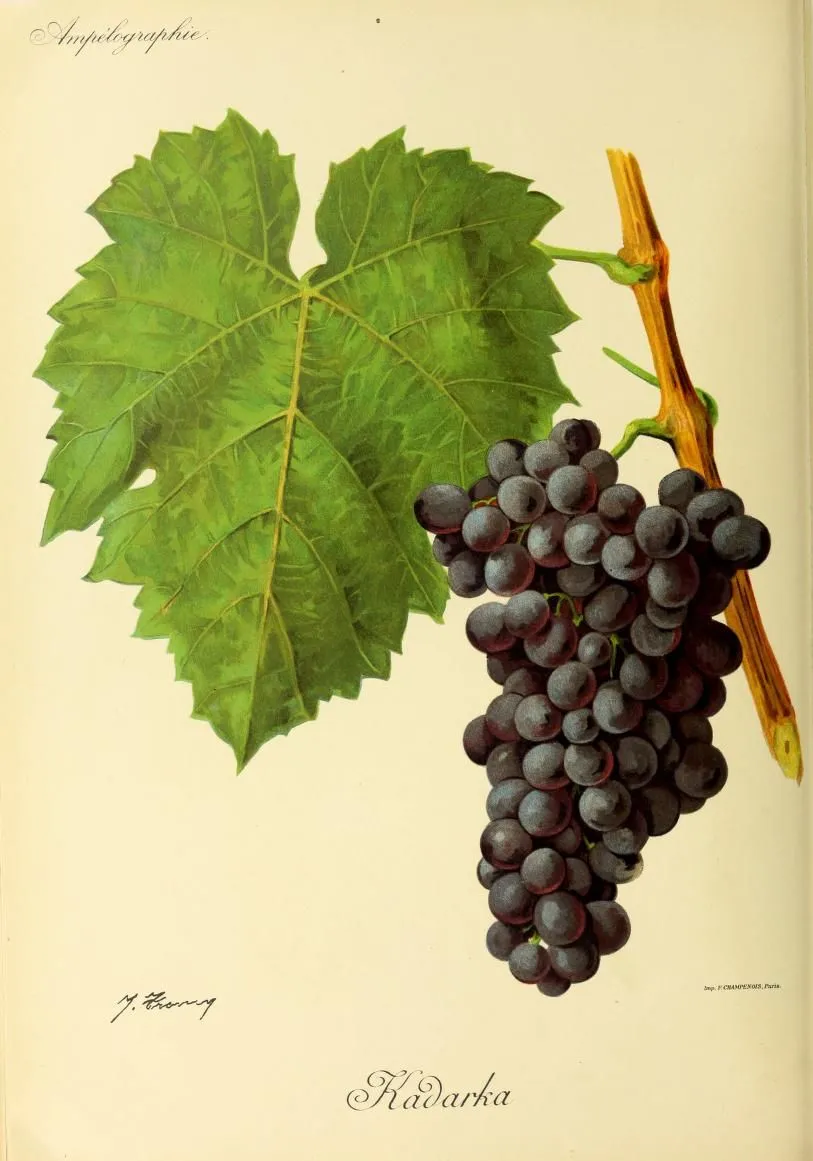
Profile: Kadarka
| Berry colour | Black grape (N) |
|---|---|
| Species / status | Vitis vinifera |
| Origin | Balkans or Pannonian basin (debated origin) |
| Parentage | Papazkarası is thought to be one of its parents (2012 DNA study) |
| Synonyms | Gamza (Bulgaria), Cadarca (Romania), Skadarka, Fekete kadarka |
| Grown in | Hungary, Bulgaria, Romania, Serbia |
| Typical aromas | cherry, raspberry, spicy red fruit, pepper, sweet paprika, floral notes |
| Wine style | Reds of light to medium colour, fruity and spicy, with supple tannins, more rarely more structured wines. |
| Food pairings | goulash, halászlé (paprika fish soup), paprika chicken, smoked charcuterie |
| Identifiers | VIVC no. 5898, Wikidata Q576867 |
Origin: between Hungary and the Balkans
Kadarka is a black grape of Central Europe and the Balkans, long the main red grape of Hungary. Its origin is the subject of two hypotheses:
- a Balkan origin, on the shores of Lake Scutari (Shkodër), on the border between Albania and Montenegro, which would explain the name skadarka;
- a Hungarian origin, defended by other authors.
A genetic study published in 2012 proposes papazkarası as one of its parents, a grape grown in the Strandja region of European Turkey, near the Bulgarian border. This result argues for roots in south-eastern Europe, without closing the debate. See our guide on DNA parentage of grape varieties.
A grape with many names
| Name | Country |
|---|---|
| Kadarka | Hungary, Serbia |
| Gamza | Bulgaria |
| Cadarca | Romania |
| Skadarka | Western Balkans |
Kadarka has dozens of synonyms, a sign of ancient cultivation and wide spread across the Danube basin. See synonyms and homonyms.
The little-known angle: the historic grape of Bull’s Blood
Bikavér, or Bull’s Blood, is Hungary’s most famous red wine. It is a blend produced in two regions: Eger in the north-east and Szekszárd in the south.
Historically, kadarka was one of the major components of these blends. In the 20th century, its area fell sharply. It was replaced in the vineyards, and in the Bikavér, by grapes judged easier and more reliable: kékfrankos, the Hungarian name for blaufränkisch, and portugieser, then international grapes.
| Period | Place of kadarka in Hungary |
|---|---|
| Until the early 20th century | Main red grape, pillar of the blends |
| 20th century | Sharp decline in favour of kékfrankos and other grapes |
| Recent decades | Revival in Szekszárd and other regions, selection of old clones |
In the vineyard: a delicate grape
Kadarka has large, compact bunches with small, almost round berries, dark blue to black. The tight bunches favour rot in a wet autumn, and the grape has a reputation for being demanding to bring to good ripeness. These difficulties largely explain its decline against more reliable varieties.
The revival relies on the selection of old clones and on controlled yields. On the value of this diversity, see our guide on clones and mass selection.
The wines
Kadarka gives reds of light to medium colour, fruity and spicy, with supple tannins. They show cherry, red fruit, pepper and sometimes a note reminiscent of sweet paprika. The best examples are often compared, for their finesse and lightness, to pinot noir, though the two are not related.
It is made as a single variety or in blends, notably in the Bikavér cuvées that claim a return to tradition.
Where it is grown
- Hungary: mainly in Szekszárd, and also in Eger and the Hajós-Baja region.
- Bulgaria: under the name gamza, it long dominated the north-west of the country and the Danube plain.
- Romania: under the name cadarca.
- Serbia and other Balkan countries, on more modest areas.
In Hungary, it sits alongside great white grapes such as furmint of Tokaj.
Kadarka and kékfrankos: two eras of Hungarian red
| Benchmark | Kadarka | Kékfrankos (blaufränkisch) |
|---|---|---|
| Historical status | Main Hungarian red grape until the early 20th century | Most widespread red grape today |
| In the vineyard | Delicate, prone to rot | More reliable |
| Colour of the wines | Light to medium | Deep |
| Profile | Red fruit, spice, suppleness | Black fruit, pepper, fresh acidity |
| Role in Bikavér | Historic | Current |
The return of kadarka answers a search for lighter, more fragrant wines, and a wish to rediscover the grapes that made the country’s wine history.
Frequently asked questions
Is kadarka a Hungarian grape?
It is closely associated with Hungary, where it was long the main red grape, but its origin is debated. One hypothesis has it coming from the Balkans, notably from the shores of Lake Scutari (Shkodër), between Albania and Montenegro, which would explain the name skadarka. Another considers it native to Hungary.
What is the link between kadarka and Bull's Blood?
Bikavér, or Bull's Blood, is a red blended wine from Eger and Szekszárd. Kadarka was historically a major component. After its decline in the 20th century, it was largely replaced in these blends by kékfrankos (blaufränkisch) and other grapes.
Is Bulgarian gamza kadarka?
Yes, gamza is the Bulgarian name for kadarka. It was long the dominant grape of north-west Bulgaria and the Danube plain. In Romania, it is called cadarca.
Related grapes
- Blaufränkisch (black, Central Europe, probably Lower Styria (present-day Slovenia))
- Portugais bleu (black, Central Europe, probably Lower Styria (present-day Slovenia))
- Furmint (white, Hungary, Tokaj (probable origin))
- Welschriesling (white, Central Europe (uncertain origin))
- Pinot noir (black, France, Burgundy)