Palomino: the grape of fino, manzanilla and oloroso
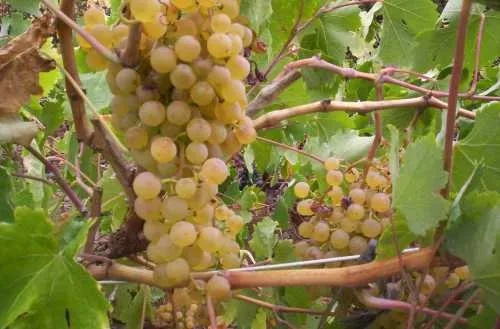
Profile: Palomino
| Berry colour | White grape (B) |
|---|---|
| Species / status | Vitis vinifera |
| Origin | Spain, Andalusia |
| Synonyms | Palomino fino, Listán blanco, Listán, Fransdruif, White French |
| Grown in | Spain, South Africa, Portugal, Australia, United States |
| Typical aromas | almond, hazelnut, bread and yeast (flor), saline and iodine notes, chamomile, walnut (oloroso) |
| Wine style | Neutral base wine, transformed by biological ageing under flor or oxidative ageing in a solera: from saline, dry fino to rich oloroso. |
| Food pairings | Iberian ham, salted almonds and olives, shellfish and fried fish (manzanilla), consommés and soups (amontillado), mature cheeses (oloroso) |
| Identifiers | VIVC no. 8888, Wikidata Q657693 |
Palomino, the sherry grape
Palomino is a white grape from Andalusia, the main grape of the wines of Jerez, called xérès in French and sherry in English. It is grown in the triangle formed by Jerez de la Frontera, Sanlúcar de Barrameda and El Puerto de Santa María, in the province of Cádiz.
Spain distinguishes several forms: palomino fino, by far the most important for sherry, and less qualitative forms, such as palomino basto, which have declined.
A paradox: the best wine from a mediocre grape
The most interesting angle on palomino is a paradox. Made into a conventional table wine, it gives neutral, low-acid wines that oxidise quickly. These same shortcomings make it the ideal raw material for sherry: a discreet base wine that lets the ageing express itself.
In Jerez, it is therefore not the grape but the cellar that makes the style.
Albariza: the white chalk of Jerez
The best palomino vineyards are planted on albariza, a white, highly calcareous soil rich in calcium carbonate. This soil retains the moisture of winter rains and releases it slowly during the very dry Andalusian summer. Its pale colour reflects light.
From flor to solera: the sherry styles
After fermentation, the base wine is classified according to its finesse, then fortified and aged in casks by one of two routes: biological ageing, under a veil of yeasts called flor, or oxidative ageing, without flor. The wines then age in the solera system, a fractional blending of casks of different ages.
| Style | Ageing | Profile |
|---|---|---|
| Fino | Under flor | Dry, pale, notes of yeast and almond |
| Manzanilla | Under flor, in Sanlúcar de Barrameda | Dry, very pale, saline and iodine |
| Amontillado | Under flor, then oxidative | Dry, amber, hazelnut |
| Palo cortado | Oxidative after a short period under flor | Dry, between amontillado and oloroso |
| Oloroso | Oxidative, without flor | Dry, dark amber, walnut and spice |
The sweet wines of Jerez, for their part, involve pedro ximénez or muscat of Alexandria, or sweetened blends.
The parallel with the vin jaune of the Jura, also aged under a veil of yeasts but made from savagnin and without fortification, is often drawn. See the grapes of the Jura.
Listán blanco: the palomino of the Canary Islands
In the Canary Islands, palomino is grown under the name listán blanco, for dry white wines, often on volcanic soils. It should not be confused with listán prieto, a distinct black grape known in the Americas under the name país. These name confusions are dealt with in the guide synonyms and homonyms.
Elsewhere in the world
Palomino is also planted in Galicia, in the Portuguese Douro, in South Africa (where it is called fransdruif or white french), in Australia and in California, often for fortified or distilling wines. In France, it is not grown in significant quantities.
In the vineyard
Palomino is productive and vigorous, well suited to Andalusian heat and drought, especially on albariza. Its low-acid, low-sugar musts explain why it is rarely made into quality table wine without acidification.
Frequently asked questions
Which grape is used for sherry?
Palomino fino is the main grape of the wines of Jerez, in particular of all the dry sherries: fino, manzanilla, amontillado, palo cortado and oloroso. Pedro ximénez and muscat of Alexandria are used mainly for sweet wines and sweetened blends.
What is flor?
Flor is a veil of yeasts that develops on the surface of the wine in casks that are not completely full. It protects the wine from oxidation and gives it aromas of yeast, bread and almond. Fino and manzanilla are aged under flor; oloroso, more strongly fortified, is aged without flor, in contact with air.
Is palomino the same grape as listán blanco?
Yes, the listán blanco of the Canary Islands is considered to be palomino. It should not be confused with listán prieto, a distinct black grape, known in the Americas under the name país.
Why does palomino make few table wines?
Its musts are low in acidity and sugar, and oxidise quickly, which gives flat still wines without correction. These shortcomings become assets for ageing under flor, which specifically calls for a neutral base wine.
Related grapes
- Pedro Ximénez (white, Spain, Andalusia)
- Muscat d'Alexandrie (white, Mediterranean basin (precise origin undetermined))
- Savagnin (white, Europe, precise origin debated (Jura and Central Europe))
- País (Listán prieto) (black, Spain, Castile)
- Ugni blanc (white, Italy, central Italy)