Pinotage: the Stellenbosch cross that became South Africa's emblem
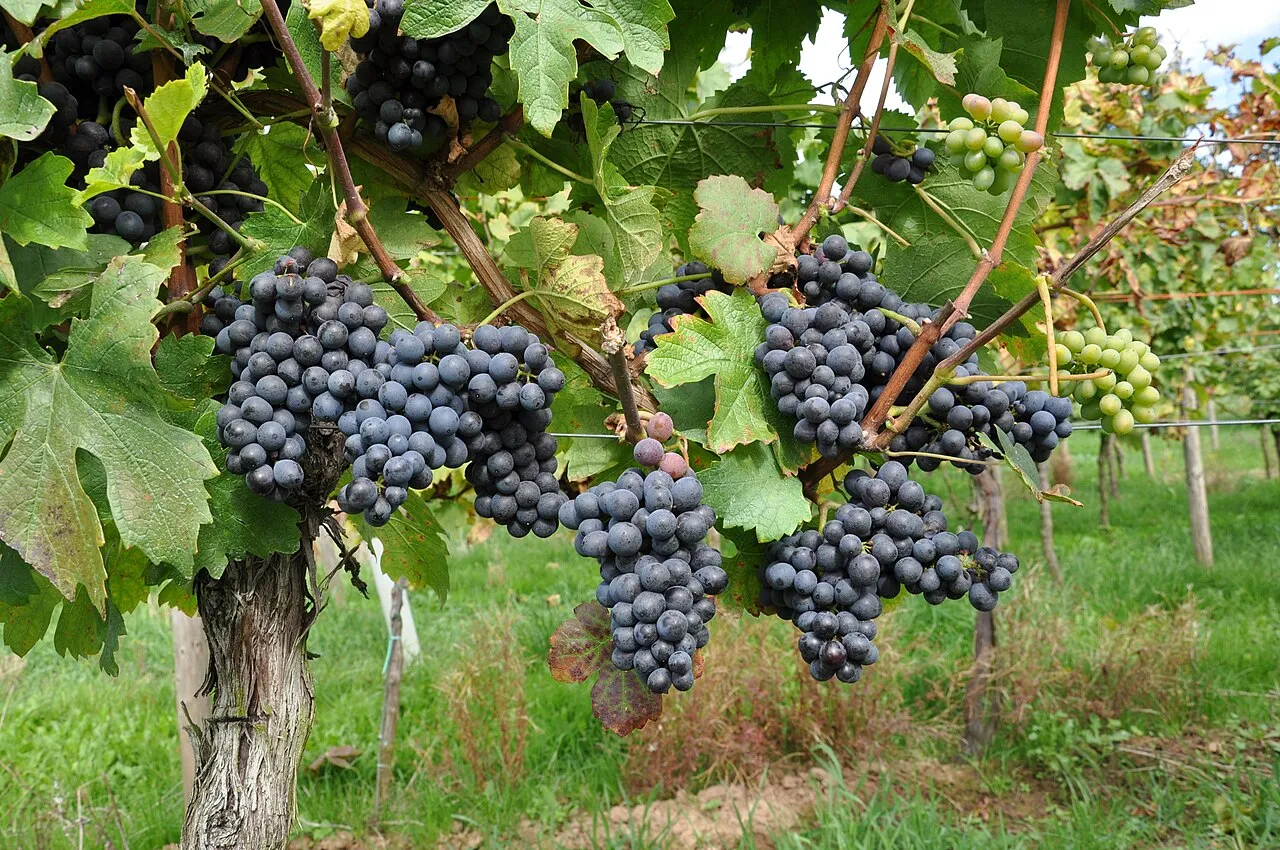
Profile: Pinotage
| Berry colour | Black grape (N) |
|---|---|
| Species / status | Vitis vinifera |
| Origin | South Africa, Stellenbosch |
| Parentage | Pinot noir × Cinsault (bred by Abraham Perold in the 1920s) |
| Grown in | South Africa, New Zealand, United States, Brazil, Canada, Germany, Israel, Zimbabwe |
| Typical aromas | blackberry, plum, black cherry, ripe banana (young), smoke, coffee and mocha ("coffee" style) |
| Wine style | Coloured, fruity and often smoky reds, from the supple style for drinking young to old-vine cuvées aged in barrel, plus rosés and sparkling wines. |
| Food pairings | braai (South African barbecue), bobotie, boerewors, game, smoked meats |
| Identifiers | VIVC no. 9286, Wikidata Q1504214 |
Origin: a laboratory cross
Pinotage is a man-made grape. It was bred in the mid-1920s (1925 according to most sources, 1924 according to others) by Abraham Izak Perold, the first professor of viticulture at Stellenbosch University, in South Africa.
Perold crossed pinot noir with cinsault, which South Africans then called hermitage. The new grape’s name combines the two: pinot + hermitage = pinotage.
The idea attributed to Perold was to combine the finesse of pinot noir, difficult to grow in the region, with the robustness and productivity of cinsault, well suited to the Cape climate. His exact motivations, however, are not precisely documented.
A story that almost ended early
The cross was not exploited straight away. According to the most often reported account, the young plants, left in Perold’s garden at Stellenbosch, were almost lost after he left the university, before being rescued by colleagues.
The young plants were then grafted, propagated and named pinotage. The first wine was made in 1941.
| Date | Milestone |
|---|---|
| Mid-1920s | Pinot noir × cinsault cross by Abraham Perold |
| 1941 | First pinotage wine |
| 1959 | A pinotage from the Bellevue estate wins first prize at the Cape Wine Show |
| 1961 | First wine labelled “pinotage”, under the Lanzerac brand |
| 1987 | A pinotage by Beyers Truter (Kanonkop) is voted wine of the year by the Diners Club |
Cross or hybrid?
Pinotage is an intraspecific cross: both its parents are Vitis vinifera. It is therefore not a hybrid in the viticultural sense, a term reserved for crosses between different species. On this distinction, see our guide on DNA parentage of grape varieties and the page on direct producer hybrids.
In the vineyard
Pinotage is a vigorous grape that ripens early and easily accumulates sugar, hence wines that can be high in alcohol. It is naturally rich in tannins and colour, unlike its parent pinot noir. It is often trained as bush vines (gobelet) in old vineyards, which give the most highly regarded cuvées.
The little-known angle: a controversial grape
Pinotage is probably the most debated grape of the New World. Its detractors criticise it for:
- notes of isoamyl acetate, reminiscent of varnish, paint or overripe banana;
- sometimes high volatile acidity;
- a smoky or “burnt” character considered overwhelming.
In 1976, visiting British Masters of Wine described its nose as “hot and horrible”. Its defenders reply that these faults are mainly a matter of viticulture and winemaking: harvesting at proper ripeness, temperature-controlled fermentation, management of maceration and oak ageing. The progress made since the 1990s, and the growth of exports during the 2010s, have largely rebalanced the debate.
The styles
| Style | Characteristics |
|---|---|
| Young, fruity red | Plum, blackberry, cherry, supple, for drinking young |
| Red for ageing | Old vines, barrel ageing, structure and depth |
| “Coffee pinotage” | Aged with heavily toasted oak, notes of coffee and mocha |
| Rosé | Fruity and fresh |
| Sparkling, fortified wine | More confidential production |
| Cape blend | Blend with Bordeaux grapes or syrah |
Coffee pinotage is a commercially successful style, with aromas of coffee and chocolate obtained through oak ageing. It divides wine lovers.
Cape blend refers to a red blend in which pinotage plays a significant part, often with cabernet sauvignon, merlot or syrah. Its exact definition remains debated.
Where it is grown
South Africa accounts for most of the world’s pinotage plantings, notably in the regions of Stellenbosch, Paarl and Swartland. There it grows alongside chenin blanc, the country’s most planted grape. Small areas are also found in New Zealand, the United States, Brazil, Canada, Germany, Israel, Switzerland and Zimbabwe.
Genealogy of Pinotage
Identified parents (Wikidata): Pinot noir and Cinsault.
Further reading
Frequently asked questions
What are the parents of pinotage?
Pinotage is a deliberate cross between pinot noir and cinsault, made by Abraham Perold at Stellenbosch University in the mid-1920s. In South Africa, cinsault was then called hermitage: the name pinotage therefore combines "pinot" and "hermitage".
Is pinotage a hybrid?
No. Its two parents, pinot noir and cinsault, belong to the species Vitis vinifera. It is therefore an intraspecific cross, like marselan, and not a hybrid between different vine species.
What is a Cape blend?
It is a South African red blend in which pinotage plays a significant part, alongside Bordeaux grapes such as cabernet sauvignon or merlot in particular. The exact definition of the required share of pinotage is debated, and the term is not strictly regulated.
Why does pinotage have a bad reputation with some critics?
Some pinotage wines have been criticised for notes of isoamyl acetate, reminiscent of varnish or paint, and for high volatile acidity. These faults are linked to ripeness and winemaking choices. Progress over recent decades, with better-controlled fermentations, has clearly improved average quality.
Related grapes
- Pinot noir (black, France, Burgundy)
- Cinsault (black, France, Languedoc (probable))
- Chenin blanc (white, France, Loire Valley (Anjou-Touraine))
- Syrah (black, France, northern Rhône Valley)
- Cabernet sauvignon (black, France, Bordeaux area)
- Gamay (black, France, Burgundy)
- Chardonnay (white, France, Burgundy)
- Melon de Bourgogne (white, France, Burgundy)