Parellada: the most delicate of the three cava grapes
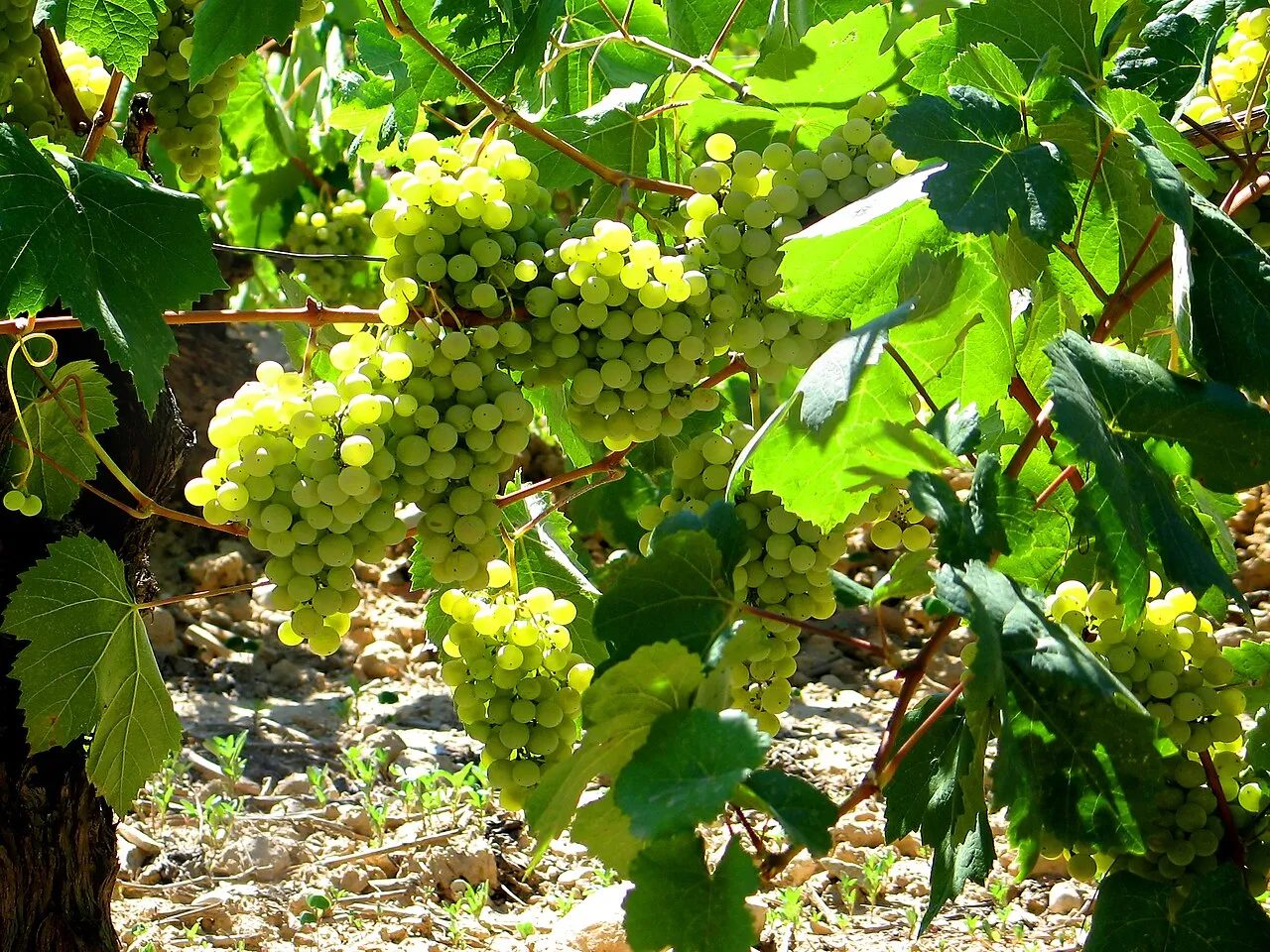
Profile: Parellada
| Berry colour | White grape (B) |
|---|---|
| Species / status | Vitis vinifera |
| Origin | Spain, Catalonia |
| Parentage | Passerille blanche |
| Synonyms | Montonec, Montonega |
| Grown in | Spain |
| Typical aromas | white flowers, green apple, citrus, pear, fresh herbs |
| Wine style | Light, floral, lively white of low alcohol, to drink young; brings finesse to cava blends. |
| Food pairings | aperitif, salads and grilled vegetables, steamed fish, light shellfish |
| Identifiers | VIVC no. 8938, Wikidata Q1751915 |
Parellada, the third voice of cava
Parellada is a Catalan white grape, grown almost exclusively in north-eastern Spain. With macabeo and xarel·lo, it forms the historic trio of cava, the Spanish traditional-method sparkling wine.
Of the three, it is the lightest and most delicate. Where xarel·lo brings body and macabeo brings fruit, parellada brings aromatic finesse and fresh acidity.
The cava trio at a glance
| Grape | Main contribution | Preferred areas |
|---|---|---|
| Macabeo | Fruit, freshness | Penedès, Catalonia, Aragon, Rioja (viura) |
| Xarel·lo | Body, structure, ageing potential | Lower and middle Penedès, Alella |
| Parellada | Finesse, floral notes, lightness | High Penedès, Conca de Barberà, Costers del Segre |
For thoughts on the value of blends, see the guide single-variety or blend.
A high-altitude grape
What is specific to parellada is its geography: it is the Catalan grape of the heights. Late-ripening, it needs slow maturation to express its aromas. In warm lowland areas, it gives flat, neutral wines; in the higher, cooler areas of the Catalan hinterland, it keeps its liveliness and its perfume.
It is therefore found mainly:
- in the upper Penedès, the highest part of the appellation;
- in the Conca de Barberà, an inland valley in the province of Tarragona;
- in Costers del Segre, further west, towards Lleida.
This spread across altitudes becomes an asset in the face of warming, as shown in the guide grape varieties and climate change.
In the vineyard
Parellada is a late-ripening and productive grape. Its bunches are fairly large. Its productivity calls for control of yields to avoid diluted wines. It is reputed to be susceptible to certain fungal diseases, which steers it towards well-ventilated sites.
The wines: lightness and flowers
On its own, parellada gives light still whites of low alcohol, with aromas of white flowers, green apple, pear and citrus. These wines are drunk young, often as an aperitif or with simple dishes.
In Catalonia, it is also blended with more aromatic grapes, such as muscat blanc à petits grains, sauvignon blanc or chardonnay, for fresh, perfumed whites.
In cava, its contribution is discreet but real: it lightens the blend, accentuates the floral notes and adds tension. Parellada remains little known outside Spain, eclipsed by the name of the cava that it nonetheless helps to shape.
Frequently asked questions
What is the role of parellada in cava?
Parellada brings finesse, lightness and floral notes to the cava blend. Xarel·lo gives body and structure, macabeo gives fruit and freshness. It is rarely the majority grape but contributes to the elegance of the cuvées.
Why is parellada grown at altitude?
It is a late-ripening grape, which gives lively, aromatic wines when it ripens slowly in cool conditions. On warm plains it tends to produce neutral wines. The high areas of Penedès and Conca de Barberà suit it better.
Are there 100% parellada wines?
Yes, notably light, floral still whites, as well as a few sparkling wines. It is also often blended with aromatic grapes such as muscat or sauvignon blanc in Catalan whites.
Related grapes
- Macabeu (white, Spain, north-east (exact origin debated))
- Xarel·lo (white, Spain, Catalonia)
- Chardonnay (white, France, Burgundy)
- Muscat à petits grains (white, Mediterranean basin (precise origin unknown))
- Sauvignon blanc (white, France, Loire Valley or South-West France)
- Pedro Ximénez (white, Spain, Andalusia)