Sciaccarellu: the fragrant red of southern Corsica
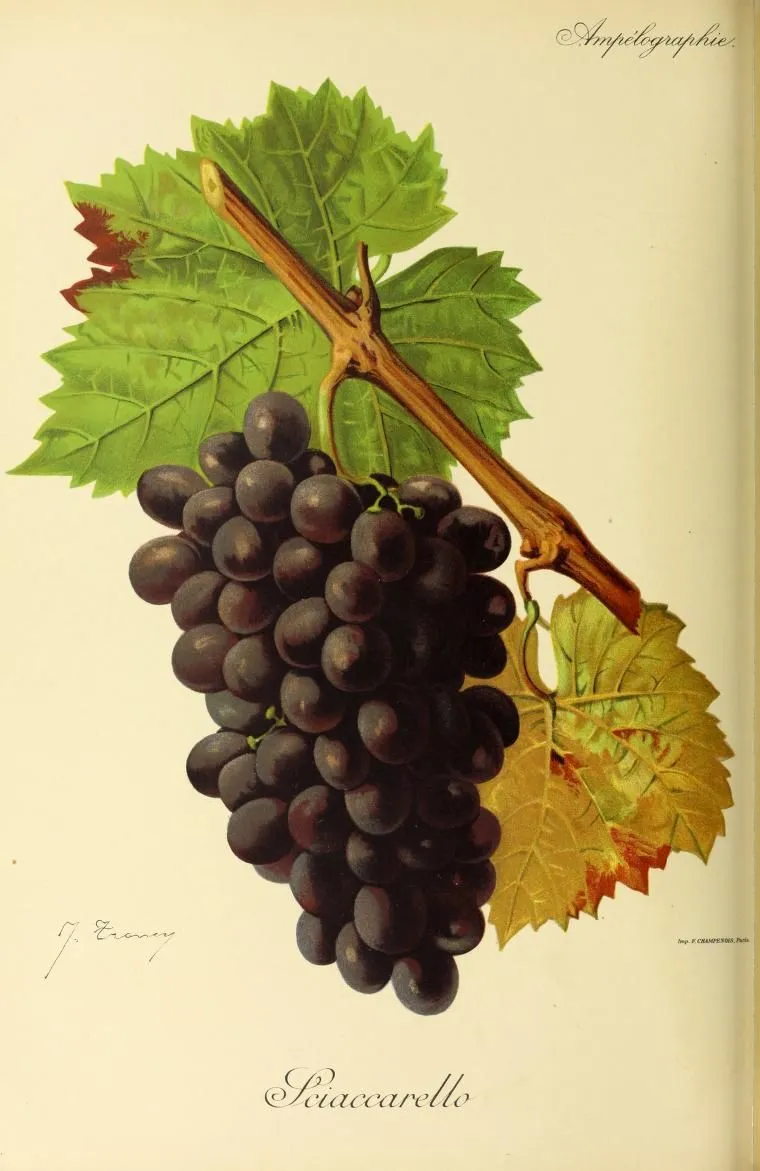
Profile: Sciaccarellu
| Berry colour | Black grape (N) |
|---|---|
| Species / status | Vitis vinifera |
| Origin | Italy, Tuscany (probable), grown in Corsica |
| Parentage | Boggione Rosso × Uva delle Vecchie |
| Synonyms | Sciaccarello, Sciacarello, Mammolo (Tuscany) |
| French regions | Corsica |
| Grown in | France, Italy |
| Typical aromas | pepper, red fruit, raspberry, dried flowers, maquis, spices |
| Wine style | Pale, supple and very fragrant reds with peppery notes, and delicate, spicy rosés. |
| Food pairings | Corsican charcuterie (lonzu, coppa), veal with olives, grilled rockfish, Corsican ewe's milk cheeses |
| Identifiers | VIVC no. 10837, Wikidata Q1527364 |
A grape of south-western Corsica
Sciaccarellu is a black grape grown almost exclusively in Corsica, mainly in the south-west of the island: around Ajaccio, Sartène, Figari and Porto-Vecchio. It has several spellings: sciaccarellu (Corsican form), sciaccarello, sciacarello.
Together with niellucciu (the Corsican name for sangiovese) and vermentino, it is one of the three grapes that define the identity of Corsican wines.
The angle to know: a Corsican grape with Tuscan roots
Genetics has made sciaccarellu an instructive case. A study published in 2007 (Di Vecchi Staraz and colleagues) revealed its genetic links with mammolo, a Tuscan grape formerly grown in Chianti and around Montepulciano. Sciaccarellu is often considered to be the same grape as mammolo, which suggests an Italian origin.
It is not an isolated case. Corsica shares several grapes with Tuscany and Liguria, the result of centuries of exchanges, notably under Genoese rule.
| Corsican grape | Italian counterpart | Colour |
|---|---|---|
| Sciaccarellu | Mammolo (Tuscany) | Black |
| Niellucciu | Sangiovese (Tuscany) | Black |
| Vermentinu | Vermentino (Liguria, Sardinia, Tuscany) | White |
In Chianti, mammolo brought a scent of violet (in Italian mammola), hence its name. Sciaccarellu, for its part, is described above all for its notes of pepper. These differences in perception owe as much to terroir and winemaking as to the grape. For the identification method, see synonyms and homonyms and DNA parentage of grape varieties.
In the vineyard
Sciaccarellu is reputed to be very well suited to granite soils, poor and free-draining, which dominate in south-western Corsica. Its berries are crunchy, a feature often highlighted to describe it.
The island’s Mediterranean climate, hot and dry, tempered by the sea and the relief, allows it to ripen while keeping aromatic freshness.
The wines
Sciaccarellu makes lightly coloured, supple wines with fine tannins, very fragrant. Its most cited aromas are pepper, red fruit, dried flowers and notes reminiscent of the maquis.
It is used:
- for light to medium-bodied reds, sometimes made as a single variety, especially in the Ajaccio AOC;
- for delicate, spicy rosés;
- in blends with niellucciu or grenache noir.
Wines from granite are renowned for their finesse and can age for a few years, although most are drunk fairly young.
Where it is grown
Sciaccarellu is almost exclusively a Corsican grape. Its benchmark appellation is Ajaccio, where it is the main grape of the reds. It is also present in the Vin de Corse AOC, notably in the Sartène, Figari and Porto-Vecchio designations.
In Italy, under the name mammolo, it is still grown marginally in Tuscany. For other little-known grapes, see rare and forgotten grapes.
Frequently asked questions
Sciaccarellu or sciaccarello: which spelling?
Both refer to the same grape. Sciaccarellu is the Corsican form, sciaccarello the Italianised form long used in French. The spelling sciacarello, with a single c, is also found.
Is sciaccarellu a Corsican or an Italian grape?
It is grown almost exclusively in Corsica, but genetic studies link it to mammolo, a Tuscan grape. It is therefore probably of Italian origin, introduced to Corsica at an unknown date, like other island grapes related to Tuscany.
Where can sciaccarellu be found?
Its benchmark terroir is the Ajaccio AOC, on granite soils. It is also found in the Vin de Corse wines of the Sartène and Figari areas, and more occasionally in other parts of the island.
Why does sciaccarellu taste peppery?
The peppery character is the grape's most frequently cited aromatic signature. It is often associated with its wines from granite. The sources do not specify the molecule responsible for this particular grape, even though rotundone is responsible for peppery notes in other varieties such as syrah.
Related grapes
- Vermentino (white, Western Mediterranean (exact origin unknown))
- Grenache noir (black, Spain, Aragon (origin disputed with Sardinia))
- Sangiovese (black, Italy, Tuscany)
- Cinsault (black, France, Languedoc (probable))
- Carignan (black, Spain, Aragon (Cariñena region))